

Is FxPro Expensive in 2025? Complete Review of Spreads, Commissions, and Trading Costs
Before you start trading with FxPro, it’s a good idea to get familiar with how the broker structures its pricing. Understanding this early on will give you a clearer picture of your overall trading costs and help you set a realistic budget for each session. It also makes it easier to pick the account type that offers the best value for your trading style.
The overview below breaks down the different types of fees you may come across when trading with FxPro. It covers spreads, commissions, swap rates, and other additional charges that apply to Forex, metals, and various other financial instruments.
If you want a straightforward explanation of what it really costs to trade with FxPro, keep reading — we’ll go through each fee in detail so you can see where your money goes.
FxPro Account Types and Pricing Models
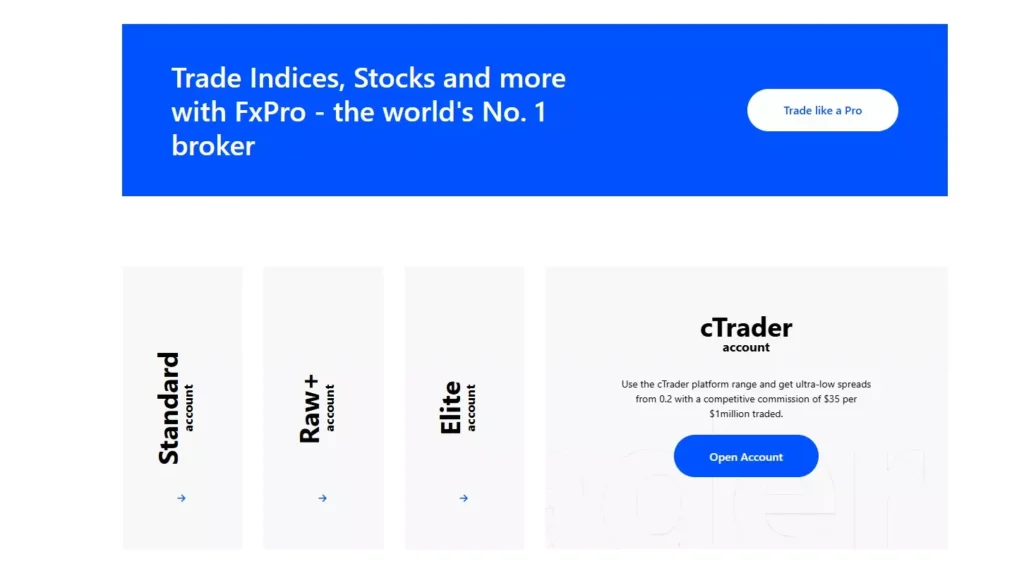
This broker offers several account types across its trading platforms — MetaTrader 4 (MT4), MetaTrader 5 (MT5), and cTrader. Each account follows a slightly different pricing model, allowing traders to choose one that best fits their strategy and budget.
1. Standard Account (MT4 / MT5)
The Standard account charges no direct commission on Forex, metals, or other instruments. Instead, FxPro incorporates its markup into the spread, which is generally wider than those of other account types. This option is suitable for traders who prefer a simpler cost structure without separate commission charges.
2. Raw+ / ECN-Style Account (MT4 / MT5)
The Raw+ account provides tighter spreads, starting from 0.0 pips on major currency pairs, while applying a low commission of $3.50 per side per standard lot. This structure appeals to traders who value precision pricing and lower spreads, even with a small fixed fee per trade.
3. cTrader Account
The cTrader account also offers low spreads and the same commission rate of $3.50 per side, making it a competitive choice for high-volume or algorithmic traders. As its name suggests, this account is only available on the cTrader platform and follows FxPro’s ECN-style execution model.
All FxPro accounts support micro lots with a minimum trade size of 0.01 lots. Hedging is allowed on all account types, while the netting system is available exclusively on Standard and Raw+ accounts.
In addition to trading fees, traders should also be aware of non-trading fees such as deposits, withdrawals, and inactivity. FxPro does not charge deposit fees, which helps keep overall costs more manageable.
2. Spread and Commission Details (2025 Update)
Below is an overview of the spreads and commissions you can expect from FxPro in 2025, based on the latest data from multiple verified sources.
Spreads
- For the Standard account (MT4/MT5), the EUR/USD spread typically starts from around 1.2 pips.
- For the Raw+ or ECN-style accounts, spreads can be as low as 0.0 pips, depending on market conditions and liquidity, with an additional commission applied per trade.
- According to recent analysis, Standard account spreads on EUR/USD usually range between 0.9 and 1.7 pips, while Raw+/ECN spreads average around 0.2 pips under normal market conditions.
Commissions
- The cTrader account applies a commission of $35 per USD 1 million traded on Forex and Metals.
- For the Raw+ (MT4/MT5) account type, FxPro charges a commission of $3.50 per side per standard lot, which equals $7 round-trip.
Example Cost Analysis
As an illustration, consider a EUR/USD trade on a Standard account with a spread of approximately 1.45 pips — this would result in a total cost of about $14.50 per round trip (for one standard lot).
By comparison, trading the same pair on cTrader, with a tighter spread of around 0.45 pips and a $3.50 commission per side, brings the total cost to roughly $16.
3. How Does FxPro Compare? Is It Expensive?
Pros
- Transparent pricing: FxPro provides clear information on spreads and commissions, making it easy for traders to understand the total trading cost.
- Flexible account structure: Traders can choose between spread-only accounts or those with raw spreads plus commissions, depending on their trading volume and strategy.
- Low non-trading fees: FxPro does not charge deposit fees and generally keeps other non-trading costs minimal.
Cons
- Higher spreads on Standard accounts: Compared to some competitors, the overall cost on the Standard (spread-only) account can be slightly higher—especially for popular pairs like EUR/USD.
- Raw+ and cTrader accounts still face competition: Although FxPro’s ECN-style pricing is competitive, some brokers may offer marginally lower spreads or commission rates on similar account types.
- Variable spreads: Since FxPro uses floating spreads, trading costs may increase during volatile market conditions or periods of low liquidity.
Verdict
If you trade small volumes using the Standard account (which has no commission), FxPro offers solid value, though it’s not the cheapest option on the market. For high-volume traders, the Raw+ or cTrader accounts—with tighter spreads and transparent commissions—can provide much better cost efficiency.
Overall, FxPro is not expensive in absolute terms, but when compared to the lowest-cost brokers, it may appear slightly higher—unless you choose the right account type and trade size to match your strategy.
4. Key Tips Before Trading with FxPro
If you’re considering opening an account with this broker, here are a few practical tips to help you make the most of your trading experience:
- Choose the right account type for your trading style:
If you trade infrequently or with small volumes, the Standard account (no commission, wider spreads) may be sufficient. For active traders, scalpers, or those trading in larger volumes, the Raw+ or cTrader accounts offer tighter spreads with a small commission, resulting in better cost efficiency. - Always calculate your true all-in trading cost:
Include every potential fee — spread, commission, overnight swap charges, and any inactivity fees. This gives you a realistic understanding of your total expenses per trade rather than focusing only on spreads. - Be cautious during volatile market conditions:
FxPro uses floating spreads, meaning even tight spreads can widen significantly during high volatility or low liquidity periods. Plan your entries carefully and use risk management tools such as stop-loss orders. - Check deposit and withdrawal options for your region:
Traders in Vietnam and Southeast Asia should verify payment methods, conversion rates, and processing fees to avoid unexpected costs due to currency exchange or third-party transfer charges. - Take advantage of loyalty or rebate programs:
FxPro occasionally offers rebate or cashback incentives based on your trading volume. Enrolling in these programs can help offset a portion of your trading costs over time.
Alternatives to FxPro: How Their Trading Costs Compare
When it comes to trading costs, this broker sits in the mid-range — not the cheapest, but known for reliability and execution quality. If your priority is minimizing fees, here’s how this platform compares with other leading brokers.
| Broker & Account Type | Typical EUR/USD Spread* | Commission / Lot | Notes |
|---|---|---|---|
| FxPro – Standard Account (MT4/MT5) | Around 1.2–1.5 pips | None | Spread-only model; costs are built into the spread. |
| FxPro – Raw+ / cTrader Account | From 0.0 pips | $3.50 per side | Lower spreads but includes commission; ideal for active traders. |
| IC Markets – Raw / ECN Account | Around 0.02–0.1 pips | $3.50 per side | One of the lowest all-in costs in the market. |
| Pepperstone – Razor / ECN Account | Around 0.0–0.1 pips | $3.50 per side (≈ $7 round-turn) | Consistently low spreads and fast execution. |
*Spreads are indicative averages and can vary depending on market conditions.
Key Takeaways
In short, FxPro remains a solid, trustworthy choice — but if your strategy depends heavily on tight spreads and ultra-low fees, alternatives like IC Markets or Pepperstone may be more cost-effective.
FxPro’s Standard account is straightforward, with no commissions, but its wider spreads make it less cost-efficient for high-frequency trading.
The Raw+ / cTrader model offers more competitive spreads but adds commissions, making it better suited to experienced or high-volume traders.
IC Markets and Pepperstone both provide industry-leading spreads and similar commission structures, offering slightly lower total trading costs overall.
Conclusion
In summary, FxPro is a well-regulated broker that combines transparent pricing, multiple platform choices, and strong reliability. However, it’s important to understand where it stands in the cost spectrum.
While FxPro is not the cheapest broker in 2025, it consistently delivers mid-range to upper-tier value when comparing total or “all-in” trading costs. For traders whose primary focus is ultra-low cost, other ECN-style brokers may offer marginally better pricing. However, FxPro’s Raw+ and cTrader accounts remain highly competitive, especially when factoring in spread stability, execution quality, and platform performance.
If pricing transparency, regulatory trust, and platform diversity are key priorities, FxPro represents a respectable and balanced choice for both new and experienced traders.
For an even clearer comparison, you can review a detailed cost table contrasting FxPro’s spreads and commissions with a few leading competitors (e.g., IC Markets, Pepperstone, or XM) to determine which broker aligns best with your strategy, volume, and region.
For a deeper dive into how FxPro stacks up against top brokers, check out our comparison articles: